Sabtu, 07 Mei 2016

synonym antonym homonym, hyphonym collacation


Synonyms

Words that have similar definitions are known as synonyms. We use synonyms constantly in speech and in writing. These are the words that can be used interchangeably, but the meaning of the message remains the same. For example, look at these two sentences:
  1. The long baseball game lasted over four hours
  2. The lengthy baseball game lasted over four hours.
Which word was changed in the second sentence? 'Lengthy' replaced the word 'long.' But did the meaning of the sentence change? No, it did not, because 'long' and 'lengthy' are synonyms; they have similar definitions. Synonyms can generally be used interchangeably without a change in meaning of the overall message.
Many synonyms are very useful because they can show different variations of the same understanding. To show this, let's look at the word 'good.' We all know the meaning of 'good.' It is one of the first understandings you come to as a child, and you learn quickly what it means to be a good kid. Generally speaking, 'good' can be defined as something correct or pleasant and enjoyable. There are numerous synonyms for good: okay, well, fine, great, excellent, magnificent and wonderful. All these words are describing a positive event or experience, but the variations can show a clearer understanding. For example, an 'okay day' is not as good as an 'excellent day.' But a 'wonderful day' is just about the same as a 'magnificent day.' The range of synonyms can give the audience or reader a better understanding of the speaker's exact intentions.

Antonym

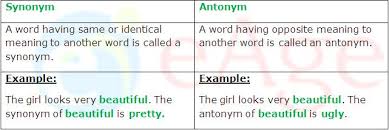
A word that has the exact opposite meaning of another word is its antonym. Life is full of antonyms, from the "stop" and "go" of a traffic signal to side-by-side restroom doors labeled "men" and "women."
Most antonyms are pretty obvious, like "good" and "bad," or "black" and "white." Some words can be transformed into their antonyms simply by adding the prefixes "un," "in," or "non," as when "likable" is changed into its antonym, "unlikable." The word antonym itself takes the Greek word anti, meaning "opposite," and adds it to -onym, which comes from the Greek onoma, or "name." So antonym literally means "opposite-name."


Homonyms

Homonyms are two or more words that have the same sound or spelling but differ in meaning. Adjectives: homonymic and homonymous.
Generally, the term homonym refers both to homophones (words that are pronounced the same but have different meanings, such as pair and pear) and to homographs (words that are spelled the same but have different meanings, such as "bow your head" and "tied in a bow").
Note that some dictionaries and textbooks define and distinguish these three terms in different ways. Some equate homonyms only with homophones (words that sound the same). Others equate homonymns only with homographs (words that look the same). See the observations below by Tom McArthur and David Rothwell. Also see Homophones and Homographs: An American Dictionary, 4th ed., by James B. Hobbs (McFarland & Company, 2006).


Hyphonym
In linguistics, a hyponym is a specific term used to designate a member of a broader class. For instance, daisy and rose are hyponyms of flower. Also called a subtype or a subordinate term. Adjective: hyponymic.
Words that are hyponyms of the same broader term (that is, a hypernym) are called co-hyponyms. The semantic relationship between each of the more specific words (e.g., daisy and rose) and the broader term (flower) is called hyponymy or inclusion.
Examples and Observations
  • "Hyponymy is a less familiar term to most people than either synonymy or antonymy, but it refers to a much more important sense relation. It describes what happens when we say 'An X is a kind of Y'--A daffodil is a kind of flower, or simply, A daffodil is a flower."
    (David Crystal, The Cambridge Encyclopedia of the English Language, 2nd ed. Cambridge University Press, 2003)


Collocation

I want to concentrate in this article on the problems non-native speakers may have with English vocabulary use - in particular with the appropriate combinations of words. This is an aspect of language called collocation. An example of collocation that many learners of English may be familiar with is the different adjectives that are used to describe a good-looking man and a good-looking woman. We talk of a beautiful woman and of a handsome man, but rarely of a beautiful man or a handsome woman.
(It is quite possible, in fact, to describe a woman as handsome. However, this implies that she is not beautiful at all in the traditional sense of female beauty, but rather that she is mature in age, has large features and a certain strength of character. Similarly, a man could be described as beautiful, but this would usually imply that he had feminine features. Calling a man pretty is most often done perjoratively to suggest effeminacy. *)
In another familiar example of collocation, we talk of high mountains and tall trees, but not usually of tall mountains and high trees. Similarly a man can be tall but never high (except in the sense of being intoxicated!), whereas a ceiling can only be high, not tall. A window can be both tall or high, but a tall window is not the same as a high window. We get old and tired, but we go bald or grey. We get sick but we fall ill. A big house, a large house and a great house have the same meaning, but a great man is not the same as a big man or a large man. You can make a big mistake or a great mistake, but you cannot make a large mistake. You can be a little sad but not a little happy. We say very pleased and very tiny, but we do not say very delighted or very huge. And so on - there are endless examples of this kind of difficulty!
The problem for the learner of English is that there are no collocation rules that can be learned. The native English speaker intuitively makes the correct collocation, based on a lifetime’s experience of hearing and reading the words in set combinations. The non-native speaker has a more limited experience and may frequently collocate words in a way that sounds odd to the native speaker.
Here are some questions to test your knowledge of collocations:
  • What is the difference between a high window and a tall window?
  • Look at the following pairs of phrases and in each case choose the most usual collocation:
    • strong tea / powerful tea
    • a strong car / a powerful car
    • a strong computer / a powerful computer
    • a strong drug /a powerful drug
  • Now look at the following words and phrases and decide if we do them or make them. For example, do we do a mess or make a mess?
a mess
a mistake
the housework
the beds
a noise
a wish
a test
a promise
a job
someone a favour
your best
a speech
the shopping
damage
a telephone call
your hair (i.e. comb it or make it tidy

http://grammar.about.com/od/fh/g/hyponymterm.htm

Jumat, 06 Mei 2016

word formation process and major formation


1) Introduction

When German native speakers converse with English native speakers, they are often astonished how easily and spontaneously new words can be created in English. At the same time, English speakers are astonished by the number of lengthy[LH1] compounds the German use in written language. But still, most word formation processes are very similar in both languages - both[LH2] English and German even share some affixes, for example be- in be-friend or be-zahlen or –er in sing-er or Säng-er.
[LH3]I want to investigate[LH4] the differences and similarities concerning the major word formation processes in English and German (compounding, derivational suffixation and conversion). Firstly[LH5], I will provide an appropriate background by looking at contrasts in the lexicon and will also touch on[LH6] some diachronic explanations. Then I will explain the different units of words[LH7].
Ultimately, I[LH8] want to get an insight into a very recent [LH9]phenomenon, namely the adding of German affixes to English words in German word formation - the so-called ‘Denglisch’.

2) Contrasts in the lexicon

Before I [LH10]explore the similarities and differences in word formation processes between the two languages, I want to provide some background information by giving a general overview of the contrasts in the lexicon and the connection between word formation and the lexicon.
First, we must be aware of the fact, that words play an active role in the shaping[LH11] of items in our imagination. This means, that if a word does not exist in a language, it is hard to grasp the meaning of it.
(1)Dunst,Nebel
(2)haze,mist,fog

We can translate haze with ‘Dunst’ and fog with ‘Nebel’, but it is hard to find an appropriate translation for mist (Mair 1995: 25). It is important to know that there are limits to the transfer of meaning from one language into another.
Another problem is false friends, which are words that look alike - often because they are rooted in the same language [LH12]– but have developed a different meaning:
loslassen ‘stop to hold’ vs. let loose ‘free from restraint’ (Mair 1995: 26)
This shows that the relation between English and German does not necessarily lead to a better understanding, but can[LH13] lead to misinterpretations (“Can I become a steak, please?”).
Especially interesting concerning word formation are two tendencies in the lexicon which can be explained through history:

·         Dissociation
The German language tends to use compounds in cases where the English uses synonymous word pairs of different etymologic origin:
(1)table/deskvs.Tisch/Schreibtisch
(2) calf/veal vs. Kalb/Kalbfleisch (Mair 1995: 29)
The reason for this is[LH14] the long periods of close language contact and bilingualism in Britain, especially after the Norman Conquest in 1066. The people who had to slaughter the animals used the English words while the French upper class used their words for the cooked meat. A large part of the Middle English vocabulary had its origin in French, in fact many thousand words (Jucker 2000: 36-38).[LH15]
·         Zero-derivation
In Old English and Early Modern English, inflectional endings were lost. This is closely connected to the settlement of the Vikings in Britain. The Danes and Norwegians would have spoken different dialects, but both languages were rather similar to that[LH16] of the Anglo-Saxons (Jucker 2000: 24). It is assumed that in order to understand each other, the endings were simply ignored. Due to this development, almost every verb, in English, can be used as a noun or the other way round (conversion), [LH17]which is often a more precise way of saying something than in German:
to carpet a building vs. ein Gebäude mit Teppichen ausstatten
The only constraints are word-class specific suffixes (Mair 1995: 29-30).
So when we look at the word formation processes, we should always keep in mind that English and German both derive from Germanic, but have been exposed to different influences over the years.

3) The components of words

To understand the word-formation processes, it is important to have a look at the units that can be combined.
There are items which are non-specific concerning word-formation processes:
·         Words
Words can be combined with all units, including themselves. [LH18] We distinguish between simple words like Torte and complex words like Apfeltorte (Donalies 2007: 10).
·         Phrases and letters
Sometimes words are composed with phrases or letters:
(1)Ich-kann-sie-nicht-vergessen-Brief
(2) B-Promis, A-list crowd (Donalies 2007: 11).
The following units are specifically needed for some word-formation processes:
Ø  Confixes
Confixes are bound units and can be combined with words[LH19], affixes and themselves. They are just used for word-formation and can define the word class. They are usually borrowed from other languages. Typical confixes are:
(1)faszin-,therm-,-skop,-zid
(2) bio-, cyber-, -minator (Donalies 2007: 12).
Ø  Affixes
Affixes are also bound units and cannot be combined with themselves. We distinguish between prefixes, suffixes and circumfixes, which are frequently used in German word formation but I did not find any examples in PDE. 
(1)  prefixes:VERsüßen,POSTmodern
(2)suffixes:SüßE,selectivITY
(3) circumfixes: VERsüßeN, GechattE, (Donalies 2007: 14-20).


4) Compounding

Compounding is the most productive type of word-formation process, both in English and in German. It can be defined as the combination of two words to form a new word. But compounds can consist of more than just two elements and these elements need not to be words (Plag 2003: 133). According to Donalies it is even most common that compounds consist of a word and a confix (Donalies 2007: 35). The more precise definition given by Plag is “[…] a compound is a word that consists of two elements, the first of which is either a root, a word or a phrase, the second of which is either a root or a word” (Plag 2003: 135).

Binary structure
In both languages all compounds are binary which means that they can be divided into two units:
(1) university teaching award committee(1) member(2) (Plag 2003: 133)
‘ member of X’
(2) Rosenbuschbegradigungs(1)experte(2)
‘n expert for X’

Right-hand head rule
Concerning the notion of the head, in both languages the left-hand member modifies the right-hand member, which is also called the head (right-hand head rule). This does not account for all languages, for example French: a café-filtre is something to drink, not something to filter (Donalies 2007: 39). The head determines the grammatical features of a word, e.g. the word class or the number. [LH21]

Stress
English and German compounds are usually stressed on the first/left-hand element, whereas in noun phrases the stress lies on the last word of the phrase. This can even lead to minimal pairs:
greenhouse (‘a glass building for growing plants’) vs. a green hóuse (‘ a house that is green’) (Plag 2003: 138)
   But there are a lot of exceptions to the rule, e.g. aluminium fóil (Plag 2003: 138) or Schienenersátzverkehr (Donalies 2007: 40).

 Extra long sounds very colloqial
 Too many „ands“
You should never in a essay, state that it is an essay or term paper that you are writing – it sounds unprofessional and informal


http://www.grin.com/en/e-book/123416/word-formation-processes-in-english-and-german-a-survey

Kamis, 05 Mei 2016

Jumat, 22 April 2016

Zero allomorph


Zero allomorph in English 
 
In morpheme-based morphology, the term null allomorph or zero allomorph is sometimes used to refer to some kind of null morpheme for which there are also contexts in which the underlying morpheme is manifested in the surface structure. It is therefore also an allomorph. The phenomenon itself is known as null allomorphy, morphological blocking or total morpheme blocking. A zero, in linguistics, is a constituent needed in analysis but not realized in speech. Specifically in phonology, it refers to an element that is phonologically null. This implies that there is a lack of an element where a theory would expect one. It is usually written with the symbol "∅", in Unicode U+2205 ∅ EMPTY SET (HTML ∅

• ∅). A common ad hoc solution is to use the Scandinavian capital letter Ø instead. There are several kind of zeros.

• A zero morph,consisting of no phonetic form, is an allomorph of a morpheme that is otherwise realized in speech. In the phrase two sheep-∅, the plural marker is a zero morph, which is an allomorph of -s as in two cows. In the phrase I like-∅ it, the verb conjugation has a zero affix, as opposed to the third-person singular present -s in he likes it.

• A zero pronoun occurs in some languages.In the English sentence nobody knows ∅ the zero pronoun plays the role of the object of the verb, and in ∅ makes no difference it plays the role of the subject. Likewise, the zero pronoun in the book ∅ I am reading plays the role of the relative pronoun that in the book that I am reading. This is also referred to as PRO. In pronoun-dropping languages, including null subject languages such as most Romance languages, the zero pronoun is a prominent feature.

• A zero subordinate conjunction occurs in English in sentences like I know ∅ he likes me, in which the zero conjunction plays the role of the subordinate conjunction that in I know that he likes me.

• A zero article is an unrealized indefinite or definite article in some languages.

• A zero copula,in which a copula such as the verb to be is implied but absent. For example, in Russian the copula is usually omitted in the present tense, as in "Она красивая" (literally: She beautiful), the same happening with colloquial Brazilian Portuguese, as in "irônicos, aqueles" (literally: ironic, those [guys]), though never with the adjective coming after the subject as usual in Romance languages. In English the copula is sometimes omitted in some nonstandard dialects.


 https://en.wikipedia.org/wiki/Null_allomorph
 https://en.wikipedia.org/wiki/Zero_%28linguistics%29